Showing posts with label politics. Show all posts

Monday, October 3, 2011

The word


It takes a supreme effort to do anything that might make me feel sorry for the ghastly Texas governor Rick Perry, but his rival for the Republican nomination Herman Cain has managed it. Apparently Perry’s family once rented a hunting lodge that we will describe as N-----head, so as to spare the blushes of those who dislike the word “nigger”. (And as a mark of my equal opportunities policy when it comes to verbal offensiveness, “Paki”, “yid”, “cracker”, “faggot”, “fuck”, “cunt”, OK?)

Cain, who is black, and made his fortune from unpleasant pizzas, has declared that there is “no more vile, negative word than the N-word” and I can see how an association with the grotesque process of lynching must make it seem that way; but surely such vileness must attach itself to “rope”, “tree”, “torch” and “mob of inbred bigots” as well. And in any case, the Perrys took action to paint over the offensive word where it appeared on the property; although they didn’t do it immediately, and apparently it was still visible under a coat of white paint this summer. So it’s not really racism or insensitivity for which Perry is being hounded, but sloppy editorial protocols. On second thoughts, the guy deserves everything he gets.

Wednesday, September 28, 2011

Hacky sack

I’m not really a journalist, you know. I mean, every now and then I do something that might loosely be defined as journalism, but ultimately I’m a bit of a dilettante. I’ve never done any real training (rather like Johann Hari, then) or taken any exams to prove my mettle; and I never quite got round the joining the union.

So I’m not really sure how it would affect me if Ivan Lewis’s proposal, that seriously misbehaving journalists should be struck off, were actually to end up on the statute book. I mean, the people who tend to get struck off are the likes of lawyers and doctors, proper professionals who have to ascribe to codes of ethical conduct. Is journalism in the same sort of zone? I would have thought that proper, trained, accredited hacks would rather welcome such a move, as it protects their jobs from the predations of cheaper, untrained wannabes, but it seems that very few of them have a good word to say about Lewis‘s proposal – possibly wondering whether certain indiscretions in their own professional lives might, under a new regime, provoke expulsion from inky-fingered Eden. In any case, the details are far too blurry: would struck-off journalists just be banned from working for newspapers? All print media? Broadcast as well? And how the hell could you stop them writing for an online product?

Talking of which, Italian lawmakers aligned with Silvio Berlusconi are trying to pass a clause that would enforce a right to reply for those who believe they’ve been defamed on a blog. The blogger would have just 48 hours to accept the submission, or face a potential fine of 12,000 euros. Which seems perfectly fair to me. If I’ve ever said anything horrid about you in nearly six years of blogging, please feel free to answer back in the receptacle provided. In Italian, though, naturally.

PS: Martin Moore of the Media Standards Trust on why a registry of journalists is a silly idea; Hari’s editor, however, seems pretty relaxed about the whole thing.

Sunday, September 11, 2011

9/11: I never could get the hang of Tuesdays


A couple of years back, I wrote a book. Maybe you noticed me mention it. Did you read it, or at least buy it and mean to read it? Some people did, which was nice. It’s still available by the way; as far as I know, no copies were looted. Anyway, it was a book about the Noughties, and as such, there was rather a lot in it about the events of September 11, 2001. Indeed, it’s probably fair to say that I cast 9/11 as the main character in the drama of the decade, the point around which everything else revolved. Which is hardly a radical piece of historical revisionism, but almost as soon as the book had gone off to press, I began to have my doubts. A few years before, I’d written a piece for The Guardian about the way that, post-9/11, the slightest disturbance in New York City seemed to trigger alarms in editorial offices in all corners of the world, even if it turned out to be caused by a common-or-garden accident; so a plane crash in NYC that kills two people is the headline in Le Monde, edging out a train crash in France that had killed 12. But in writing the book, I’d put my scepticism to one side, and worked within the mainstream, Applecentric perspective.

But it still niggled: was this agenda really viable? Was 9/11 really the lynchpin of the decade, for everyone from Beijing to Bamako? Were the 230,000 people wiped out by the 2004 tsunami really a smaller blip on the decade’s radar than the 3,000 who died in the terrorist attacks? In some of the articles I wrote to tie in with the book, I did try to raise the possibility that the overwhelming significance of 9/11 was a question of geopolitical perspective, but I really didn’t have the courage of my convictions. (I hope, however, that I’ve earned a little kudos for linking the phrase “false dawn” to the election of Obama.) Anyway, multiple brownie points to David Rothkopf, whose Foreign Policy article identifies 10 – T*E*N! – things about the past decade that were bigger than 9/11.

Also: the late David Foster Wallace, in 2007, tells the truth by asking questions; Rupert Cornwell on a wasted decade; Blackwatertown offers the journalist’s angle; Mrs Peel checks out the visuals; and Christopher sums up everything so neatly and sweetly that I don’t know why the rest of us bother.

But I will anyway. Since everyone’s been pitching in with their where-were-you-when story over the past few weeks (we’re all Zapruders now), I’ll bore you with mine one last time. I was in the British Museum, which had a small display dedicated to the work of the architect Norman Foster. I was particularly interested in the Millennium Tower, a projected development in Tokyo which, had it been constructed, would have been the tallest building ever. To give some idea of scale, they put the model alongside simulacra of about a dozen other buildings that had been, at the time of their construction, the tallest in the world, going back to the Eiffel Tower. So, when I got the call telling me that the first plane had hit (I seem to remember the news of the second strike coming while I was looking for a pub with a telly) I was standing over a model of a building that never was, and a couple that very soon wouldn’t be.

(The image above is an Indian pharmaceutical ad from around 2003, courtesy of Gothamist. And below is a place where the towers still stand.) 

Monday, August 15, 2011

The barbarian


I don’t know whether David Starkey is a racist. I doubt very much whether he knows either, because the word has ceased to have any empirical meaning, now being little more than a Humpty-Dumpty term of socio-political abuse (see also “politically correct”). But – probably inadvertently – he has raised another issue, about black culture. Or rather cultures, as his fellow panellist Dreda Say Mitchell argued, rightly pointing out that black British people should not be defined as a group  in terms of second-hand gangsta archetypes.

But if this is the case, that there is no single, homogeneous black culture, surely the same applies to the majority (dominant, mainstream, white, British, Judeo-Christian, whatever you want to call it) culture. Starkey probably wouldn’t wish to be defined by the antics depicted on The Only Way Is Essex. Indeed, I suspect he wouldn’t wish to be defined by comparison with Simon Schama or Niall Ferguson either. And if it’s impossible to define culture at the micro-level of self-publicising TV historians, (What would the collective noun be? A pontification?) then how the hell can you do it on a broader scale? What is white culture, English or British or western culture? It’s everything, and as such is nothing.

While the neds and scallies and oiks and rudies of all colours were smashing windows and burning buildings, it was Dr Starkey who – again by accident – laid waste to culture as we know it.

(Five Chinese Crackers weighs in, with just the right combination of passion and forensics; and you’ve probably already read Charlie Brooker on bling, but anyway. And then Rhodri Marsden on how the above video clip fits into everything. You may be none the wiser, but don’t say you aren’t better informed. PS: And also something about the contribution of urban [non-]planning, by Owen Hatherley. Do I spoil you or what? That said, I might write about something unriotous next time.)


Thursday, August 11, 2011

It was a pleasure to burn...

Apparently bookshops have for the most part evaded the attention of the looters; and a Waterstones employee was heard quipping that this is a pity, because “if they steal some books they might learn something.” Which did prompt me to throw together a quick reading list that might throw a little light on the situation, and it was looking something like this:
...when I noticed the delightful Bidisha pointing out that a TV show made for Amnesty International was made by a team of 11 white men and... er... that’s it. And my boring liberal conscience kicked in, and I wondered whether it really matters, but if it does, are there any books by women and/or people who aren’t Caucasian that might be added to my list?


(Title half-inched from the opening of Ray Bradbury’s Fahrenheit 451. Image ramraided from the delectable Photoshoplooter. And while we’re vaguely on the subject, if you think reading matter is sacrosanct, look at this.)

PS: As if someone heard me, Bookmarks has come up with a list. It’s more inclusive than mine, but not that much.

Monday, August 8, 2011

The revolution will not be televised if they nick all the televisions


(Those who have been following me on Twitter over the past few hours may find some of these observations a little familiar. My only defence is that, in true postmodern spirit, I’m just looting myself.)

A year and a bit ago, there was a period of civil disturbance in Bangkok. I wrote something about it at the time. It’s not helpful – nor is it my place – to divide the participants into goodies and baddies, but I think it’s fair to say that most of the protesters originally came to the city with honestly held grievances. In their view, the democratic process had failed them, after elected governments aligned to Thaksin Shinawatra were forced out of office, first by the army, then by the courts. Non-violent protest degenerated into something nastier, 90 or more people were killed, and much damage was inflicted on the city. But, as far as I’m aware, nobody stole any flat-screen TVs.

Some of the more strident opponents of the protesters argued that if this is how ordinary Thais behaved when they had the merest sniff of democracy, it might be better for the country if it were sealed off from these new-fangled notions for a few years. To his credit, Prime Minister Abhisit rejected such a move, in due course called an election, and was soundly defeated by Yingluck Shinawatra, Thaksin’s sister/proxy. So the protesters got pretty much what they wanted but – crucially – they got it through the ballot box, not through brute force.

Recent events in London and beyond seem to have followed an initial trajectory that’s superficially similar to that of the Bangkok protests, with a peaceful demonstration against a perceived injustice getting out of control. But what happened next was at once less serious (nobody, so far as we know at the moment, is dead) and more reprehensible, as participants quickly ditched all pretence to a political motive and began to loot and burn for its own sake. Condemnation was quickly and rightly forthcoming from all quarters, even if some of the proposed responses (water cannons, troops on the street, martial law, shoot on sight) suggested that some people don’t follow recent events – those in Bangkok, for example – as closely as they might. And some other rumours banging around Twitter, such as the meme that the animals had been released from London Zoo, just prove that some people read too many John Irving books.

The looters in London and Birmingham and Liverpool and elsewhere don’t have the excuse that they were the victims of an anti-democratic fiddle; moreover, they’re considerably wealthier, in material terms, than most of the farmers and labourers who marched under Thaksin’s banner. The electoral system in Britain is far from perfect, but by chance, last year’s election gave an outcome that was closer to the intentions of the voters than many in recent times: as ever, no one party took an overall majority of votes, and unusually, no one party was able to govern unaided. It wasn’t the result I wanted, and maybe it wasn’t what the people lugging flat-screen TVs through smashed shop windows wanted (an analysis of voting behaviour among the hooded opportunists might throw up some surprises, although I suspect not) but it’s what happened.

But just because the looters aren’t noble, selfless freedom fighters, it doesn’t mean their behaviour doesn’t warrant analysis. It was in that spirit that I tweeted:
The looting is an unholy synthesis of welfare dependency and consumer capitalism. Discuss.
...and while some appreciated the contribution, and some agreed, and some didn’t, one or two hinted that such Hegelian chin-stroking is inappropriate right now, that our responses should be practical or emotional, but not intellectual; after all, not that many bookshops were ransacked over the past few nights. It’s pretty sad when the word “understanding” becomes freighted with negative connotations; if you’re trying to understand a criminal, does it really mean that you automatically want to hug him and forgive him and buy him a Wii? Surely it’s quite consistent to want to understand and analyse an act of wrongdoing, and at the same time to sympathise with the victims and punish the wrongdoers and try to prevent the whole fiasco from happening again.

Or should we just say fuck it, and wheel out the water cannons?

PS: Hurrah! Zoe Williams brings Baudrillard to the (street) party!

PPS: And at Prospect, David Goodhart throws a slug of Fukuyama into the punchbowl...

Wednesday, July 20, 2011

Gloup, Gloup


The consensus seems to be that Jonathan May-Bowles, aka Jonnie Marbles, the man who tried to liven up the Murdochs’ appearance before the Culture, Media and Sport committee is something of a berk, a wally, a twunt and possibly even worse. A few conspiracists have even argued that he has to be in the employ of News International, because his intervention provoked sympathy for the embattled Rupert (who of course would then deny having anything to do with him, and he certainly didn’t pay him).

The language used to cover Marbles’s contribution is interesting: most hacks have reported the empirical reality that his weapon of choice was “a paper plate of shaving foam” or words to that effect. Had it been defined as a pie or a tart – since, after all, shaving foam is the main constituent of the pies that a circus clown might fling, although you have to let them stand for an hour or two to get the sting out – the attacker might have been seen as a confrère of the heroic Noël Godin (aka Georges Le Gloupier) the Belgian entarteur whose victims include Bill Gates, Nicolas Sarkozy and Jean-Luc Godard.

Those who criticise Marbles suggest that his activities distracted from the bigger story, the ritual inquisition of those ultimately for the hacking scandal; the Labour Party has primly suspended his membership. In reality, with the exception of the redoutable Tom Watson, the committee’s questions were pretty bland, and I’m pretty sure that at one point Murdoch Senior actually nodded off. Marbles is on the naughty step, not because he attacked Murdoch, but because he implicitly attacked the whole rotten system that implicates politicians, police and media, smug pigs with their expensively manicured front trotters in the same trough. He’s in trouble not for what he did, but for what he meant. And the fact that his Twitter following rocketed in the minutes after that sublimely “WTF?” moment should also raise a question mark or several with regard to the shallow, transient celeb culture that the Murdoch press has helped to foster over the past few years.

Which is not to insist, of course, that he isn’t still a bit of a twunt.

PS: Mr Marbles in his own words; and, at Pickled Politics, Sunny Hundal comments on the comments.

Friday, June 24, 2011

Dog whistle politics


At CNNGo, I admit to not understanding the Thai election campaign, but I’m pretty sure I’m not the only one...

Friday, June 10, 2011

Don’t vote, it only encourages them


An election looms in Thailand, and the roadsides are festooned with images of awkwardly gurning candidates, most of which survive a matter of days before being stolen or defaced. The most interesting are those put up by a spin-off of the People’s Alliance for Democracy which, notwithstanding its name, argues that popular democracy isn’t entirely suitable for Thailand. Although PAD activity was to a great extent responsible for the accession of current Prime Minister Abhisit Vejjajiva in 2008, the organisation holds all the mainstream parties in fairly low esteem, albeit reserving its fiercest condemnation for former Premier Thaksin Shinawatra and his cronies; as such they are depicted in unflattering animal guises.

As such, the Electoral Commission has banned the posters, on the basis that they don’t advocate any particular candidate, and because they’re the wrong size. The notion of “a plague a’ both your houses” seems just a little too nihilistic for Thailand’s image as the Land of Smiles. A pity; I liked the monkey. (More on posters here.)

Meanwhile, the big talking point is the success of the Bangkok-set über-sequel The Hangover II, and whether it presents Thai culture in a positive and/or accurate light. My friend Cod deals with the conundrum at CNNGo. And if you don’t understand the minutiae of local politics, you’ll just have to trust me: the following, from Thai White Papers via Punk Planning, is rather amusing.

Thursday, May 19, 2011

Revenge of the analogue


When Mayor of London Boris Johnson decided to stage a Q&A on Twitter yesterday, he must have known that few of the queries would be about the microeconomics of bin collection. I was delighted to have one of my own posers identified as one of the more left-field.

But it’s so easy to take the piss with a keyboard. As pointing and laughing and shopping and banking and flirting and everything else migrates online, it’s far more heartwarming to find the real world flexing its muscles. First, author Andrew Kessler has opened a bricks-and-mortar bookshop in New York City, selling just one title – his own book about the 2008 Phoenix Mars mission. Obviously it’s a publicity stunt – a deception in which I’ve just implicated myself – but it still serves as an impudent yah-boo to Amazon and e-readers and everything else that threatens the world of paper and foxing and remainders and mildew and tachiyomi.

And then there’s the indignity meted out to Fang Binxing, the man who designed the so-called Great Firewall, that restricts what Chinese netizens can see. A virus or a concerted spamming or some other digital inconvenience might have been the obvious tactic, but no: someone threw shoes and an egg at him. It’s Ai Weiwei meets Noël Godin, and quite right too.

Tuesday, May 17, 2011

The Bloated Ego That Annoyed America


Finally, it's done. After spending the last few weeks promoting himself and musing over the prospect of running for President of the United States (only in America, you say?), Donald Trump gave up the attempt by saying he'd be back (yet again) for another edition of Celebrity Apprentice next year. The show, incidentally, should be retitled D-list Has Been Rehab Refugees And What The Hell Were You Thinking Signing Off On This Show You're Supposed To Be Better Then This Yes You Marlee Matlin How Dare You Apprentice.

This man is certainly one of the biggest, if not the biggest egos on the planet. He's also one of the most obnoxious wastes of oxygen on the planet. Hell, let's be honest. He is the most obnoxious waste of oxygen on the planet. Everything this vain, loud mouthed, bloated, hairpiece challenged egomaniac does is for the glorification of himself. Strangely enough, he can't see just how bad that hairpiece (or combover, take your pick) really is. An odd thing in someone so self absorbed.

Everything he does is for attention. Including the occasional musing of a Presidential run that he knows he could never possibly win. Why not? Well, it's kind of hard to win an election when everyone who knows you hates you. Think about it. Can you imagine anyone in this man's life who genuinely likes him? Oh, sure, he's got a pack of yes-men around, people on the proverbial Trump gravy train, but would any of them give a damn if he was choked to death in his sleep by his own hairpiece? No. Therefore, let's face it... everyone who knows him hates him.

Anyway, while Trump was making an ass of himself by trying to feed into the Birther delusions about the President (before the President totally pwned him with the birth certificate and the whole killing Bin Laden double whammy), editorial cartoonists were busy making fun of him.


Of course, four years down the line, he'll be musing about yet another kick at the can. By this time Celebrity Apprentice will include Jennifer Aniston, Justin Bieber, that Old Spice guy, and Kato Kaelin. Or did Kato already do a spin on that show? It's so hard to keep track of these so called "celebrities".


Imagine the following, if you will. Seven hundred years in the future, in the ruins of what was once Atlantic City, an archaeologist leads a class of school children among the debris. They stop before a slab of concrete that still bears the damaged letters TRUMP on it. The archaeologist turns and speaks.

"Before the late twentieth century, the word trump was often used as a term in playing cards or as falsification of legal charges. After the dark times, it also meant strange hairpiece. Arrogance. Blowhard. Long ago, after his fifth attempt at running for President of the United States, the one called Donald Trump had a meltdown, causing what became known forever after as the Great Ego Implosion of 2024. It annihilated this city from the face of the earth, killing hundreds of thousands of people. It was only the second time in history such an event happened, after the Las Vegas Annihilation Event ten years before, caused by the ego meltdown of a singer named Celine Dion." 

Tuesday, May 10, 2011

Early closing


Anish Kapoor appears to be a good bloke. Not only does he create large-scale artworks involving mirrors and catapults, that manage to please bohemian chin-strokers and casual passers-by alike, but he has declared his support for his fellow artist Ai Weiwei, who is being held by the Chinese authorities: Kapoor has dedicated his new installation in Paris to Ai, who has been accused of unspecified “economic crimes”.

But what, apart from dignified speeches, can an artist do? Gestures might mean something on China’s doorstep – as the artists of Hong Kong are attempting to prove – but what about Paris or London or New York? Kapoor revealed his preferred tactic on this morning’s Today programme: “Perhaps all museums should be closed for a day.”

Now, as a writer and a blogger, I’m as guilty as anyone of ranting from the sidelines then hiding before anyone suggests I might care to don the captain’s armband. But I’m trying very hard to picture a senior Party apparatchik in Beijing hearing the dread news that the V&A will be shut next Thursday and immediately ordering that the beardy artist should be released. Maybe stick to the mirrors and catapults, mate.

Saturday, May 7, 2011

Trump, Osama and the postmodern presidency

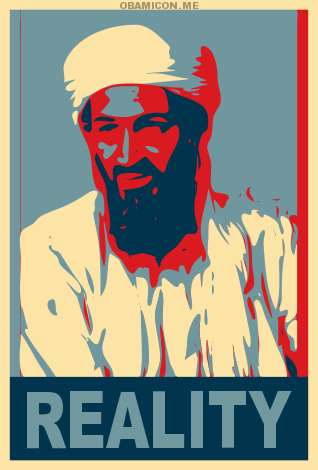
All modern politicians are, to a greater or lesser extent, simulacra. The important thing is not what they are, or what they do, or promise to do: we choose to elect or reject them because of what they mean, what they represent and reflect. Barack Obama is a classic example of this, entering the White House as a physical embodiment of hope, change and a vague aspiration towards a post-racial America that aspired to redemption from the past few centuries of slavery and prejudice. The persistent criticism levelled against him since he won the 2008 election – and not just by his political opponents – is that he has remained content to be rather than do, to offer a succession of plausibly hopey-changey soundbites in place of coherent policy and action.  His Nobel Peace Prize was effectively awarded for Not Being Another Old White Guy. As was said of Lord Kitchener, at least he made a good poster.

But then, in the past couple of weeks,  Obama started to do things, or so it seemed. His first act was provoked by the claims from Donald Trump that he had not been born in the United States and as such was not eligible to be President; Trump’s campaign was of course a continuation of the so-called birther movement, that had been making similar insinuations since before Obama had been elected. Again, he was criticised for his inaction: if he really had been born in the USA, why didn’t he just come up with the relevant slip of paper? In fact, Obama was playing a political version of Muhammad Ali’s rope-a-dope against George Foreman in 1974, soaking up the punishment in the knowledge that he was in possession of the killer punch. Or was it? After all, the die-hard birthers will continue to insist that the certificate Obama produced is a fake. And even those of us who are not members of the deranged wing-nut community have to admit that the certificate is just another simulacrum, a paper representation of an event that came and went nearly 50 years ago, and as such can never be regained.

All that paper became irrelevant when Obama announced that Osama bin Laden was dead, provided you didn’t believe that he’d died four or nine years ago, or that he had never existed at all. Many of those that chose to take the news at face value began USA!USA!USA!-ing in Times Square, but the story soon turned out to be about yet more simulacra, as the White House pondered whether we’d be allowed to see images of the body. Of course, any such image would inevitably have been dismissed as a fake – there had already been a bad fake doing the rounds, just to test the waters – while at the same time being dismissed as triumphalism on the part of Americans. The closest we could get to reality was a shot of Obama and his team watching the action taking place in Abbottabad, but it subsequently transpired that this was a fake as well, or a dramatic reconstruction, whichever is the closest. And in any case, even if we were to see a convincing, authenticated representation of Osama’s body, by the time we saw it the alleged subject of the picture would have been feeding the fauna in the Indian Ocean for several hours, just another event beyond the scope of representation, beyond any notion of truth or reality.
Related Posts Plugin for WordPress, Blogger...