Showing posts with label journalism. Show all posts

Tuesday, October 25, 2011

If we shadows...


Up to 80 people a night, we are informed, have been walking out of the current RSC production of Marat/Sade, revolted by scenes of torture, masturbation and dwarf/bishop sex. The Daily Telegraph would have us believe that those behind the show will be upset by this, I rather suspect that they’re rubbing their hands with delight, and even more keenly now that hordes of Telegraph readers are spitting thick-cut marmalade over their tweed pyjamas at the very thought of such goings on and yearning for the days when they could go to the theatre secure in the knowledge that the closest they’d come to moral depravity would be Richard Briers almost – but not quite – saying “bloody hell”. In a world where boundaries of taste and morality seem about as solid as Bangkok flood barriers, it takes something special to earn one’s transgressive Brownie points. (And would the notion of a transgressive Brownie provoke similar outrage? I wonder.)

That said, the “up to 80 people” (hmm...) are leaving voluntarily, rather than being carried out. I was lucky enough to see the Deborah Warner version of Titus Andronicus at the RSC, nearly a quarter of a century ago, and chatting to one of the ushers in the interval, I was informed that I’d come on a slow night: nobody fainted; nobody vomited; they hadn’t had a nervous breakdown in the audience for over a week. The dwarf and the bishop will just have to try that little bit harder.

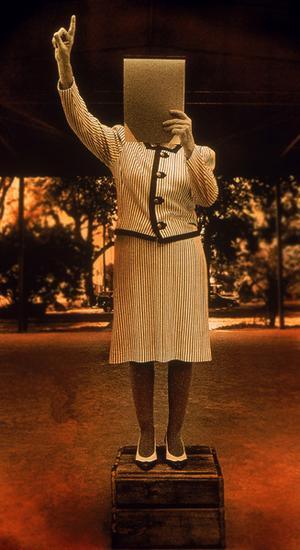
(Image by djailledie, after Jacques-Louis David, from deviantART. Flood update: still dry.)

Wednesday, September 28, 2011

Hacky sack

I’m not really a journalist, you know. I mean, every now and then I do something that might loosely be defined as journalism, but ultimately I’m a bit of a dilettante. I’ve never done any real training (rather like Johann Hari, then) or taken any exams to prove my mettle; and I never quite got round the joining the union.

So I’m not really sure how it would affect me if Ivan Lewis’s proposal, that seriously misbehaving journalists should be struck off, were actually to end up on the statute book. I mean, the people who tend to get struck off are the likes of lawyers and doctors, proper professionals who have to ascribe to codes of ethical conduct. Is journalism in the same sort of zone? I would have thought that proper, trained, accredited hacks would rather welcome such a move, as it protects their jobs from the predations of cheaper, untrained wannabes, but it seems that very few of them have a good word to say about Lewis‘s proposal – possibly wondering whether certain indiscretions in their own professional lives might, under a new regime, provoke expulsion from inky-fingered Eden. In any case, the details are far too blurry: would struck-off journalists just be banned from working for newspapers? All print media? Broadcast as well? And how the hell could you stop them writing for an online product?

Talking of which, Italian lawmakers aligned with Silvio Berlusconi are trying to pass a clause that would enforce a right to reply for those who believe they’ve been defamed on a blog. The blogger would have just 48 hours to accept the submission, or face a potential fine of 12,000 euros. Which seems perfectly fair to me. If I’ve ever said anything horrid about you in nearly six years of blogging, please feel free to answer back in the receptacle provided. In Italian, though, naturally.

PS: Martin Moore of the Media Standards Trust on why a registry of journalists is a silly idea; Hari’s editor, however, seems pretty relaxed about the whole thing.

Thursday, September 1, 2011

Quality control

Sean Adams, top banana at the splendid Drowned in Sound music site, yesterday tweeted thus:
Persnickety perfectionist comment posters unite! Donate to a fund for full-time sub-editors for websites you’re charged nothing to read...
Well, um, yes and no. It must indeed be deeply galling to devote huge chunks of one’s free time to an online project that has brought entertainment and information to hundreds of thousands of readers, none of whom have paid you a farthing for the privilege, and then have one of them point out that in the midst of a 7,000-word retrospective on the career of the big lad who looks like a farmer from Boyzone, the author uses “affect” when she really means “effect” and thus must be a bad writer who knows nothing of the big lad’s work and thus the whole site is entirely worthless. And Adams does hint at one of the dirty little secrets of mainstream media, the fact that plenty of people who appear to be Good Writers (whatever that may mean) probably wouldn’t be labelled as such if it weren’t for the assistance of subs and fact-checkers and other mostly anonymous troubleshooters. Their contribution to journalism is as great as that of plastic surgeons to Hollywood, and don’t you forget it.

Moreover, as budgets at mainstream media outlets get tighter, while at the same time the sheer volume of content required increases, the need for such quality control become more transparently obvious. Every few days, it seems, a local newspaper somewhere outsources its sub-editing function, and the result is never an improvement (except, possibly, on the balance sheet). And then there are those established papers that have jumped on the blogwagon, but don’t feel the need to extend the benefits of an editorial once-over to those who huff and puff under their brand identity. I do find it amusing that Toby Young, who has become a standard bearer for the Free Schools movement, still makes egregious grammatical errors on his Telegraph blog, which are only eradicated after readers (the digital ghostbabies of Simon Heffer, perhaps?) have pointed them out.

But at the same time, that shouldn’t be a permanent get-out clause for writers who don’t have big money behind them. Andrew Keen and his like sneer at bloggers and other one-person bands because they’re not Proper Journalists, even when they’re not trying to be Proper Journalists (which is, of course, different from Good Writers, but that’s another thing). However, that doesn’t mean that bloggers don’t have a duty to use language accurately and appropriately, and even more importantly, to get their facts right, and to respond graciously if someone points out a mistake. To shrug and say, “What do you expect? It’s only a blog,” is to do the haters’ work for them, and reinforces an us-and-them scenario in online media which should have been redundant five years ago. (And incidentally, I know that’s not what Sean Adams was doing. He was, after all, decent enough to let me write a piece for him a while back.)

OK, you persnickety perfectionist comment posters, tell me what I’ve done wrong.

Saturday, July 9, 2011

Screws


My grandfather was a respectable member of the bourgeoisie who ran his own drapery shop and played bowls. I think he may even have been a Freemason. And he read the News of the World, because the sports reporting was good, and because “we need to know these things are going on in the world.”

I don’t think he would have felt the need to know these things.

If the News of the World, as has been suggested, is replaced by a Sunday edition of The Sun, I make one suggestion: that Rebekah Brooks should make the tea. And that she never be permitted to take a holiday.

(Image by Political Scrapbook.)

Monday, July 4, 2011

Hacks and hackers

I know some of my regular readers think I’ve been a little soft on Johann Hari. For what it’s worth, I think what he did was wrong, and I’ve never done it myself; but I’m probably guilty of other varieties of journalistic sleight of hand, and I’m pretty certain many of the hacks who joined in the digital lynching over the past week would also admit to having taken the occasional liberté with the actualité if you bought them a drink or two. In any case, if the latest revelations about the phone-hacking saga are accurate, Hari’s misdemeanours begin to look more like silly youthful indiscretions by comparison.

Anyway, in The National I’ve written a more considered piece about the ramifications of young Johann’s shenanigans. On reflection, I should perhaps have included Keats’s gag about truth and beauty, but that would have been on top of Capote and Eliot. Excessive quoting probably isn’t appropriate in this context.

PS: Some have taken exception, it seems. “Uric philosophy”, indeed.

Tuesday, June 28, 2011

I’m Johann Hari! No, I’m Johann Hari...


The journalist Johann Hari stands accused of plagiarism, but plagiarism of a very specific kind. He has admitted that when writing up interviews, he sometimes takes remarks that his interviewees have made in other media and inserted them in his own piece, if they make the relevant point better.

The fact is that printed interviews are seldom accurate transcriptions of the words spoken. “Um”s and “ah”s are excised; evident malapropisms and grammatical infelicities are corrected, especially if someone is not speaking in his or her first language; very often, what goes in is what the speaker clearly meant to say, not what was said. If this didn’t happen, interviews would be all but unreadable. If journalists are being dishonest in tidying text up in this manner, then I plead guilty to dishonesty.

Hari has been accused of deception, in suggesting that his interviewees have said things to him that, in fact, they said or wrote on other occasions. But people who are interviewed on a regular basis often find themselves being asked the same questions, and inevitably come up with similar answers each time. (I mentioned this phenomenon in my Leonard Cohen biography, if anyone out there has yet to acquire a copy.) All Hari has been doing is to offer the most elegant variation on a theme that his subject has uttered.

In fact, it could be argued that Hari’s behaviour is marginally more honest (less dishonest?) than that conducted by most hacks. When someone just tidies up a transcript, the resulting phrase is something the interviewer never said; when Hari lifts from the interviewee’s previously reported comments, at least it’s the real deal.

(Although, come to think of it, if Hari’s lifting from an earlier interview, who’s to say that the relevant journalist hasn’t already done a bit of judicious tidying to the text? And if he’s lifted from the interviewee’s own writing, it’s quite possibly been edited to a greater or lesser extent – by someone other than the writer – before seeing the light of day.)

Hari may have been rather more cavalier with his sources than his readers might have guessed, but provided the meaning is intact, little real harm has been done. Perhaps those of his fellow hacks baying for his blood should be required to swear to the absolute accuracy – remember those “um”s and “ah”s – of the quotations in their own material.

PS: And then, the inevitable Downfall video...

PPS: Hari’s own take on the brouhaha.

Saturday, June 11, 2011

Is this the way they say the future’s meant to feel?

Andy Warhol, in addition to painting soup cans and movie stars, and making extremely long films, and getting shot, and generally being Andy Warhol for a living, was nominally the manager of the Velvet Underground in their early days. However, it’s probably fair to say that his duty of care to the degenerate art rockers was no more hands-on than his attitude to production of his art (which, once he’d had the idea, was often undertaken by his acolytes). In one interview around that time (1967-ish), he admitted that the band members didn’t actually get paid for their labours. “But how do they eat?” asked the journalist, aghast. “Um, well, they go to a lot of parties,” deadpanned Andy.

This came to mind a few days ago, when a marketing guy from one of the big riverside hotels in Bangkok asked me if, in my sometime capacity as a food journalist, I’d like to come over and sample the delights of the Italian restaurant there. I said I’d be delighted, but I wasn’t sure whether the usual outlets for my prandial witterings would be able to find space any time soon. “No problem,” he said. “If you could just give it a mention on your blog, that would be great.”

It all falls into place: Warhol had unwittingly created the model for journalism in the 21st century. Readers don’t want to pay for journalism, and advertisers are increasingly unwilling to subsidise it. The only way a hack without a private income can survive is on freebies, scraps from capitalism’s table (almost literally, in the case of food writing).

Two problems present themselves here. The first is that it gives an unfair advantage to those writers who specialise in the necessities of life, such as food and shelter and clothing. I have an image of emaciated literary bloggers desperately attempting to trade in their review copies with their foodie colleagues in the hope of getting a decent meal for the first time that week. That said, perhaps it might be a good idea if media were to focus on what people need more than what they can be persuaded to desire. [Thinks: Damn, does that mean nobody will want to send me free books any more?]

The other potential glitch is that the hacks might feel obliged to say only nice things about the products they’re being offered, since the alternative is starvation. But this has always been a problem under the old system, as publishers try to keep advertisers sweet, while also maintaining their hacks’ delusions that they’re morally pure seekers after truth, rather than enslaved rearrangers of the cultural slush. So it’s fortunate for me that the meal was most enjoyable (especially the whipped salt cod with avocado), and I have no hesitation in suggesting that Giorgio’s at the Royal Orchid Sheraton is very good and you should all go there, provided you tell them I sent you.

Monday, May 2, 2011

Osama bin Laden: what really happened


PS: Osama’s mansion/compound apparently had no internet access, to avoid attracting attention from US intelligence: in the end, this very anomaly was one of the things that attracted their attention. If he’d got broadband, but only used it to look at old Dr Who clips on YouTube, he might have got away with it.

PPS: It’s come to my attention that if you Google “osama bin laden what really happened” at the moment, this post appears on the first page. If that’s how you came here, welcome! Feel free to have a look around. Let us know what you think. Fancy a cup of tea, maybe a custard cream? And, um, yes. Terror of the Autons. Sorry about that.

PPPS: OK, if you do want something a bit meatier, here’s DE Wittkower’s splendid piece on the role of social media in the search for Osama; and here’s a slightly more depressing roundup of some of the Facebook responses to the big news; and here’s evidence that dead-tree media hasn’t been doing that much better.

Friday, April 29, 2011

Moon on a stick (the statutory vaguely Royal-Wedding-themed post)

Stewart Lee was, I suppose, a bit of a spear-carrier when I first became aware of him; in the period when comedy was supposedly the new rock and roll, if Newman and Baddiel were the Sex Pistols, Lee and Herring were somewhere between the Damned and the Lurkers. Their TV show, Fist of Fun, was amusing, but the most memorable bits were mostly supplied by Kevin Eldon in the guise of Simon Quinlank, King of Hobbies. And subsequently Lee became one of the lost souls in the self-devouring cycle of Moderately Cerebral Blokish Radio DJ Double Acts Consisting Of Ex-Comedians, Journalists And/Or Musicians. (Essentially, first there was Lee and Herring, and [Andrew] Collins and [Stuart] Maconie – ex-NME, Select, etc – and [Mark] Radcliffe and [Marc] ‘Lard’ [Riley] – ex-The Fall and various other post-punk entities – and then suddenly there was Radcliffe and Maconie, and Collins and Herring, leaving Lee and Lard on a metaphorical shelf somewhere, which is like a real shelf, but in less immediate need of dusting.)

But then suddenly he was back, fatter and balder and pinker and apparently having read more books. In the past week or so he’s written two pieces for British broadsheets that deserve wider attention. First, in the Financial Times of all places, he lays out his principled opposition to the notion that he ought to be creating comedy that can be tweeted or txted, as part of a wider attack on the whole notion of the creative person as a mere content provider. His work is quotable sure, but in passages and paragraphs, and even then you lose some of the context. For example, from the FT article itself:
But today content is king and form is mutable. Can the comic become a film? Can the film become a game? Can the book become an e-book? Can the song become a ringtone? Imagine if the Japanese super-robots the Transformers were suddenly put in charge of all human culture. Here’s a Jacobean tragedy you can also use to mix trifle! Content is being dictated by its possible application to a variety of forms.
And from his most recent TV show:


And just to prove that Lee’s content extends beyond his own metaphorical navel fluff (which strangely finds its way from his metaphorical midriff to the metaphorical shelf mentioned above, where comedians and musicians and journalists who don’t make the grade are sent to die, possibly metaphorically), here he is in The Guardian on the subject of some wedding or another that’s happening today. There’s been some pretty extraordinary content created about this event, and I thought it had simultaneously reached its zenith of weirdness with the Kate and Wills roast dinner, but Lee goes one better by explaining the nuptials in terms of the Grail myth, with reference to the Fisher King and TS Eliot:
The prince has taken his lowly bride from within this charged landscape, where our ancestors celebrated the union of man and woman in stone and earth, and began the communal processes that forged a nation from their descendents, the broken nation that William the Fisher King must now heal. Our shaman-prince could not have chosen a better receptacle for his magical purposes than Kate Middleton, a peasant-spawned serf-girl, sodden with the primordial mire of the Swindon-shadowed swamplands.
Try txting that, you bastards...

PS: More cogent analysis of this utterly speshull day, from Marco Evers in Der Spiegel and Will Self in the New Statesman. Have fun, everyone, and don’t eat all the bunting!

Sunday, April 17, 2011

Well, they wouldn’t, would they?

People complain about how sordid and salacious the British tabloids are, but in reality they’re incredibly prim. Take, for example, The Sun’s coverage of someone out of Girls Aloud getting married. She’s doing the deed at what the paper’s tuggin’-me-forelock-squire stylesheet requires us to describe as “posh Cliveden House”; we are then informed by our helpful hack that the place has also hosted the nuptials of a Liverpool footballer, and the one out of Ant and Dec who isn’t Dec. Oh yeah, and every British monarch since 1714.

What s/he doesn’t bother to mention is Cliveden’s real claim to fame; as the place where Jack Profumo met Christine Keeler, setting in motion a series of events that exposed the decadence and hypocrisy of the British establishment, paving the way for the Wilson government and the social upheavals and reforms of the 1960s. Maybe they didn’t like to mention this, since a sex scandal that really mattered, really changed history and society, makes the recent exploits of the Murdoch camp seem even more desperate and tawdry. Or maybe they were just cutting and pasting from a press release sent to them by Cliveden’s current management, who probably don’t like to draw attention to such unpleasant details (although, if they’re reading this, a Profumo weekender/pool party would almost certainly pack the place out).

Or maybe the hack had just never heard of Profumo, marshalling the “before my time, guv” excuse. Which is a pity: to be ignorant of what occurred before you were born is to remain always a child, as Cicero put it. For the benefit of Sun journalists, that’s either the Cicero who plays in midfield for West Brom, or the one who got kicked off Big Brother 7. Or perhaps the one who isn’t Ant.

Sunday, March 20, 2011

Monday, March 14, 2011

Imanust

That was odd. I don’t know how it happened, but for a few minutes today, the BBC’s online coverage of the post-quake scenario in Japan was running backwards. Not out of sequence: properly backwards, waves receding, boats reassembling, flames shooting back inside a nuclear power station and being capped by the intact roof, emergency teams yanking loaded stretchers out of ambulances, death and disaster unhappening itself before our eyes. All accompanied, of course, by a suitably Lynchian narration. And because, for most of us, the image and the reality have become inextricably confused, I almost – almost – half-believe that it really is unhappening, that it really all was a bad dream. And then some anonymous Beeb techie realised what was happening and pressed the right button – or unpressed the wrong button – and it all went horribly real again. Except that it was as if you’d seen the Wizard of Oz on the toilet, and for a while, the vile reality still felt a bit dreamy.

In cyberspace no one can hear you yawn

Jay Rosen at SXSW on Saturday, trying to heal the rift between bloggers and legit hacks, announced: “It’s one internet. The news system now incorporates the people formerly known as the audience.”

Which is all well and lovely, but if the audience isn’t the audience any more, who are we talking to?

Thursday, March 3, 2011

But it doesn’t move me

Musician John Roderick, in Seattle Weekly, is bored with bored music hacks and their boring boredom:
But the median level of music writing has declined, much of it hovering consistently at the level of bratty piss-taking. The number of reviews I’ve read in the last year that contain the word “meh” just boggles my mind, as though we’re expected to consider the writers’ own boredom more fascinating than the music they’re charged with critiquing.
Roderick unwittingly disparages the music that he’s ostensibly defending; very often it really is less interesting than the response, and it takes an almighty effort to write anything more helpful than “Here is another record by Coldplay and it sounds like a Coldplay record and Coldplay fans will like it” or variations thereon. “Go on,” says the real critic, “impress me.” And all too often there is no reply. Only when music (or any other product) is magnificent, or ghastly, or teetering somewhere between the two, is it worthwhile making any comment. A critic is not obliged not to be bored, any more than an artist is obliged not to be boring.

Moreover, what’s wrong with boredom as an attitude, as a stance, as a provocative statement of intent? Ennui, disaffection, meh-ness has been a key component of youth culture and popular music for decades: the Situationists saw it as an inevitable response to the banality of modern life, and it reached its zenith in the glory days of punk. I think it was Schopenhauer – although it may have been Rat Scabies – who said “Life swings like a pendulum backwards and forwards between pain and boredom.” And a reviewer musing on his or her own pain is, perversely, even more tedious than one who goes on about boredom.


PS: On vaguely parallel lines, listen to this interesting Radio 4 documentary about on French punk, available till next Thursday.

Friday, January 28, 2011

Audience figures

Tim Radford, in The Guardian, offers his 25 commandments for journalists. The first:
When you sit down to write, there is only one important person in your life. This is someone you will never meet, called a reader.
A nice idea, but for many hacks there’s a third person in the marriage: the advertiser. And if you’ve already taken that into account, what about the person who only comes in search of gently fruity pictures of Charlotte Rampling? (Or for that matter Helen Mirren, Anita Pallenberg, Princess Margaret, Su Pollard...)

Saturday, December 11, 2010

White write

Something I penned for The National, the English-language daily in Abu Dhabi, where I have never been, unless you count the inside of the airport. Still not happy with the ending. But I rarely am.

Tuesday, November 30, 2010

The ballad of Samuel K Amphong

Some time in the late 1970s, when the letters page of NME occupied an equivalent level of cultural significance to, say, Stephen Fry’s Twitter feed today, the following epistle appeared:
Where is Beatles band? This band who have not been as of late clear of circumstance. Beatles Band! Can we no longer hear there medolious throng? John! Paul! All in Beatles Band come forth! What question have we to put? Now? Arguments neccessary can begin with whole results expected for any return. Ringo! Here in Thailand Beatles band experience is long loved and can be hurt away from John, Paul etc. Please give any news to Samuel K. Amphong of address similar to above. yours as in rock!
Samuel K Amphong, Thailand
It is lost in the mists of time and sulphate as to whether this was a genuine enquiry or a bit of space-filling devilment on the part of Danny Baker, but more than three decades later, I set off to find out. The answer is here. Sort of.

Sunday, November 21, 2010

Yummers

Usually when I tell people I’m in Thailand, their immediate response is “Oh, the Thai people are all so lovely and gentle,” to which the only sensible response is that some of them are. And some are abject arseholes, and most of them are a mixture of the two, just like Swedes and Peruvians and Moroccans and, well, any nationality really. And then they tell me how utterly bloody wonderful the food is in Thailand and I say pretty much the same thing. The difference is, every now and then I’m allowed to help out with a bit of qualitative analysis of the food, as I did recently for CNNGo’s Best Eats survey. Take a look, and feel free to disagree violently, ideally from a position of ignorant prejudice.

Maybe I should do the same thing on the people.

Monday, November 15, 2010

Twhat?

I know I really shouldn’t get wound up by anything Janet Street-Porter says any more, especially if it’s published in the Daily Mail, but her latest diatribe about social media is just too idiotic to ignore. “Tweeting lets you think you’re important — it confuses activity with content,” she opines. Neglecting to consider, of course, how this distinguishes a Twitter account from, say, a column in the Daily Mail.
Related Posts Plugin for WordPress, Blogger...