Showing posts with label postmodernism. Show all posts

Wednesday, September 21, 2011

A postmodern post-mortem: or, the metafictional paradox of Ernie Wise’s hairpiece


So postmodernism has an exhibition dedicated to it, which probably means that it’s dead. Hari Kunzru (in The Guardian) and Edward Docx (in Prospect) would both agree, although they differ over the precise cause: the former says it was 9/11 and the internet, while the latter thinks we all  just got bored and decided to read Jonathan Franzen novels instead. They are unanimous, however, that: a) postmodernism as a movement was characterised by a desire to break away from pre-ordained notions of taste, morality, even reality, but aside from that it’s quite tricky; and b) the Talking Heads movie Stop Making Sense was very postmodern indeed, thank you. The problem is, though, that as soon as they agree on b), the validity of a) gets a bit of kicking; if postmodernism was tearing up the canon, it’s entirely inappropriate that it can only easily be defined with reference to a canon of its own. (Although in a truly postmodern universe, the concept of “inappropriate” also ceases to have any meaning.)

The same problem applies to such pieces of chinstrokery as Stuart Jeffries’ 10 key moments in postmodernism (also in The Guardian) and a slightly older 61 postmodern reads (from the LA Times). In this instance, if you *are* on the list, surely you can’t come in. Part of the problem is that postmodernism remains all but ineffable, and so rather than formulate a coherent definition of what it is, we find it far easier to point to individual fragments of cultural jetsam and say, yeah, that’s postmodern, so if you see something else like that, it probably is as well.

Which leaves me with two thoughts. First, if authenticity and sincerity  and Franzenicity are the concepts that have replaced postmodernism in our collective affections, then how do we deal with the likes of Jade Goody or William Hung, who have commodified “realness” into a sort of hyperauthenticity, bewitching the media with their finely spun un-spun-ness?

The other notion is that to be truly postmodern is to be self-aware, to go through life flanked by metaphorical quotation masks. And yet if you point too hard and too long, it rather spoils the joke. Which is why the defining artefact of postmodernism should not be a Talking Heads movie nor a Philip Johnson building nor even a pair of Tracey Emin’s pants, but Ernie Wise’s wig, which became a cultural touchstone for an entire generation, despite the minor inconvenience of its non-existence. In fact, it took the notion of the simulacrum into places that even poor, dear Baudrillard couldn’t have conceived: you could see it as an original (Wise’s hair) pretending to be a copy (Wise’s wig) of something that purported not to exist any more (the hair again); or indeed as a reality that wasn’t real, masking – literally and figuratively – something that had never existed (Wise’s baldness).

Now, get out of that.

Sunday, June 26, 2011

Bosphorescence


Hagia Sophia in Istanbul began life in 360 as a cathedral, became a mosque in 1453, and then reopened as a museum in 1935. The resulting juxtaposition of Christian iconography and Islamic calligraphy says much about the city’s location at the cusp of Europe and Asia, and one can derive all sorts of optimistic fortune cookies about people of all faiths and cultures and races just getting along fine. It also suggests that there was a time when Muslim culture was a little more relaxed about depictions of human figures.

As you come out of the main dome area, and a sign to your right points you to a gallery. It’s not quite clear whether this is meant in the architectural sense – a long balcony – or the more conventional modern notion, of a place to put pictures. In fact, if you wind your way up a series of cobbled ramps, you find that it’s both. The area offers a a closer look at the magnificent dome, and also a view down on the nave, and all the other tourists taking photographs. But there are also a few more artworks hanging here: and at the moment they are photographs of the mosaics that you’ve just seen, and that the people down there are photographing. I can’t decide whether it’s deliciously postmodern, or all just a bit redundant.

Then we go to the gift shop and buy fridge magnets.

Saturday, May 7, 2011

Trump, Osama and the postmodern presidency

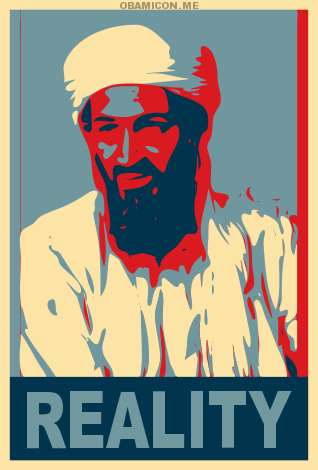
All modern politicians are, to a greater or lesser extent, simulacra. The important thing is not what they are, or what they do, or promise to do: we choose to elect or reject them because of what they mean, what they represent and reflect. Barack Obama is a classic example of this, entering the White House as a physical embodiment of hope, change and a vague aspiration towards a post-racial America that aspired to redemption from the past few centuries of slavery and prejudice. The persistent criticism levelled against him since he won the 2008 election – and not just by his political opponents – is that he has remained content to be rather than do, to offer a succession of plausibly hopey-changey soundbites in place of coherent policy and action.  His Nobel Peace Prize was effectively awarded for Not Being Another Old White Guy. As was said of Lord Kitchener, at least he made a good poster.

But then, in the past couple of weeks,  Obama started to do things, or so it seemed. His first act was provoked by the claims from Donald Trump that he had not been born in the United States and as such was not eligible to be President; Trump’s campaign was of course a continuation of the so-called birther movement, that had been making similar insinuations since before Obama had been elected. Again, he was criticised for his inaction: if he really had been born in the USA, why didn’t he just come up with the relevant slip of paper? In fact, Obama was playing a political version of Muhammad Ali’s rope-a-dope against George Foreman in 1974, soaking up the punishment in the knowledge that he was in possession of the killer punch. Or was it? After all, the die-hard birthers will continue to insist that the certificate Obama produced is a fake. And even those of us who are not members of the deranged wing-nut community have to admit that the certificate is just another simulacrum, a paper representation of an event that came and went nearly 50 years ago, and as such can never be regained.

All that paper became irrelevant when Obama announced that Osama bin Laden was dead, provided you didn’t believe that he’d died four or nine years ago, or that he had never existed at all. Many of those that chose to take the news at face value began USA!USA!USA!-ing in Times Square, but the story soon turned out to be about yet more simulacra, as the White House pondered whether we’d be allowed to see images of the body. Of course, any such image would inevitably have been dismissed as a fake – there had already been a bad fake doing the rounds, just to test the waters – while at the same time being dismissed as triumphalism on the part of Americans. The closest we could get to reality was a shot of Obama and his team watching the action taking place in Abbottabad, but it subsequently transpired that this was a fake as well, or a dramatic reconstruction, whichever is the closest. And in any case, even if we were to see a convincing, authenticated representation of Osama’s body, by the time we saw it the alleged subject of the picture would have been feeding the fauna in the Indian Ocean for several hours, just another event beyond the scope of representation, beyond any notion of truth or reality.

Saturday, April 30, 2011

The black death

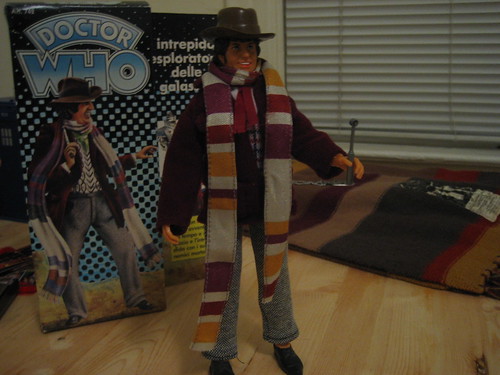
When I was rather smaller than I am today, I was a fan of Doctor Who. Actually, I say I was a fan, but fandom is an entirely relative concept. I watched the show religiously, of course. And I’d also seen both the movies (in which Peter Cushing played the Doctor) when they cropped up on TV. But my loyalty wasn’t all-consuming. I can’t remember ever going to the Longleat exhibition, for example. I did buy and read lots of the Target novelisations, but I wasn’t a completist, and in the end I sold my collection. And although I pestered my mother to up the family’s fibre intake so I could amass the Weetabix card set, I’ve no idea what happened to it; the same goes for the 10th anniversary Radio Times special and the Tom Baker doll. I started to lose interest some time during the Romana era, and by the time Colin Baker’s unlovely persona had dragged the show into an 18-month hiatus, I barely noticed. By comparison with some fans, I was a complete bloody lightweight.

One area into which I did put a little extra effort was in writing my own Doctor Who fiction. To be honest, even there I was something of a dilettante, as I don’t think I ever finished a story. I’d come up with a title, something like The Daleks of Doom, or  maybe Doom to the Daleks, then begin with an incredibly violent opening passage, usually involving the spectacular destruction of several Ogrons. (These were the hulking, simian sidekicks of the Daleks, who helped them with the stuff they couldn’t do in those days, like carrying things and climbing stairs. I think I saw them as analogous to the hard boys at school who were good at football and laughed at my glasses and said Doctor Who was for poofs.) Then the Doctor would arrive and survey the carnage and wonder what was going on and so would I and I’d go off and have some lemon squash and forget about it.

One thing I didn’t do was to attempt to render the stories that I’d seen on TV as prose. This was partly because of the existence of those Target books: I knew that if I waited long enough, Terrance Dicks or Philip Hinchcliffe or someone like them would put each story between covers. Instead, I was intent on creating my own narratives, even if they were never going to go anywhere. Of course, after the show had gone off air, an entire sub-culture of original stories appeared in print form, with hundreds of books to keep the Who brand alive, but as I said, I was well out of the loop by that point.

Although I was careful not to tread on Target’s turf, I probably took a few hints from the books, albeit subconsciously. (Not that I have any examples of my deathless genius to hand, and I suspect they suffered the same fate as the Weetabix stuff, so this is all based on my increasingly fuzzy memory.) I wasn’t a slave to the house style, though: the Target books were careful not to acknowledge the real-world status of Doctor Who, beyond a cursory acknowledgement of the scriptwriter of the story on which the book was based. So the much-derided artwork might depict the actor who played the Doctor, but Pat or Jon or Tom never got a mention. Instead, there would be a stock explanation of which incarnation was in play, such as:

THE CHANGING FACE OF DOCTOR WHO. 
The cover illustration of this book portrays the third DOCTOR WHO whose physical appearance was altered by the Time Lords when they banished him to planet Earth in the Twentieth Century.

Whereas I preferred:

THE CHANGING FACE OF DOCTOR WHO. 
The cover illustration of this book portrays the third DOCTOR WHO who was played by Jon Pertwee.

Moreover, whenever a character in a Target book incurred the wrath of the Daleks, there would be a searing flash of light, a scream, and the unfortunate individual would slump to the floor, often with wisps of smoke rising from his body. Whereas I knew what happened to people who were exterminated. They went negative. You could see it happening. So when the Daleks exterminated someone or something in my stories (I’m not sure how old I was when I realised that “exterminate” was a proper word, not one invented for the purposes of the show, like TARDIS) I’d write something along the lines of “The Dalek fired his gun and everything went negative and the Zygon died.”

In many ways, it betrayed an early fondness for metafiction and similar postmodern japeries, although at that stage I probably thought metafiction was next door to Metebelis III. Yes, that’s the sort of thing that passed for humour back then. These days, although I do like the resurrected Who immensely, it’s more of an indulgent, nostalgic fondness. Although I finally have a sofa with plenty of space behind it, I don’t hide there. And in retrospect, I even feel a tiny bit sorry for the Ogrons.

Saturday, April 23, 2011

In the beginning was the word count

In what feels like a 21st-century update of Yes, Virginia, there is a Santa Claus, a six-year-old child in Scotland was tasked by her teacher with writing a letter to God, asking how he was invented. The girl’s father – who happens to be the journalist Alex Renton – forwarded the letter to a number of religious leaders, including Rowan Williams, the prophetically beardy, Incredible-String-Band-digging Archbishop of Canterbury. Dr Williams’s reply imagined the Almighty’s response, which in his version ended thus:
Rather like somebody who writes a story in a book, I started making up the story of the world and eventually invented human beings like you who could ask me awkward questions!
Now, I’m not sure how this chimes with orthodox Anglican theology, but it sounds to me like a textbook example of metafiction, the literary device by which the author persistently draws attention to the fictional nature of the text itself. Examples range from the works of Laurence Sterne, Luigi Pirandello and Italo Calvino to that bit in Trading Places where Eddie Murphy looks straight into the camera. So there’s a respectable precedent; but it does rather suggest that while he was busy inspiring the Bible, God would occasionally break off to say “You do know this is just a story, right?”

Happy Easter, everyone!

Monday, January 10, 2011

Madness and civilization


The casual reader, so we are constantly told by erudite literary pundits such as Charlotte Rampling, Anita Pallenberg and/or Princess Margaret in the bath, is usually won or lost within the first couple of sentences. Here’s a fine example of how to begin a book review (in this instance, of George W Bush’s Decision Points, by Eliot Weinberger in the London Review of Books):
In the late 1960s, George Bush Jr was at Yale, branding the asses of pledges to the Delta Kappa Epsilon fraternity with a hot coathanger. Michel Foucault was at the Societé française de philosophie, considering the question, ‘What is an author?’

The two, needless to say, never met...

Sunday, November 7, 2010

All the somebody people


I used to write letters to newspapers and magazines. People did, way back then. Possibly inspired by Morrissey, I began with the weekly music press (something about an album of Velvet Underground out-takes, I seem to recall) before moving on to the broadsheets, and also the likes of Time Out, Esquire and the Modern Review (which used to offer free subscriptions for every letter published – I got a free subscription for writing a letter asking how many free subscriptions Germaine Greer had earned). Here, from 2004, is an epistle to The Spectator:
Roger Scruton’s invocation of Manet in his attempt to demonstrate the existence of the soul is flawed (‘What it means to be human’, 20 March). ‘Bar at the Folies Bergère’ ‘is’ a young woman only in the sense that the viewer, familiar with the conventions of Western representational art of the 19th century, puts that interpretation on it. As Magritte pointed out, ‘Ceci n’est pas une pipe.’ It is, rather, we who translate the artist’s efforts into a woman, a pipe, sunflowers, etc... Similarly, ‘the soul’ exists within human existence only to the extent that believers interpret existence thus. The idea that a work of art is ‘real’ and the idea that God is ‘real’ rely on the same intellectual and emotional characteristic — suspension of disbelief. 
But five years ago today, I started blogging, an idea that seized several other people around the same time. Perhaps not entirely coincidentally, the letters ceased. But as you can see from the above example, the content has remained pretty much the same. In this case, the message transcends the medium.

Saturday, September 4, 2010

That winking feeling

(Inspired by Reverse Stockbroker.)
Wryly Metafictional Authorial Self-Reference is dying of overwork.

“Are you there, Paul Auster?” he croaks from his bed.

“Yes, I’m here,” says Paul Auster. He owes so much to the old rogue.

“And Martin Amis, are you there?”

“Of course I’m here,” replies Martin Amis, his voice cracking.

“And JG Ballard? Kurt Vonnegut? Douglas Coupland? Are you all there?”

“Yes, we’re here,” they say. “We’re all here.”

And Wryly Metafictional Authorial Self-Reference suddenly sits bolt upright and yells, “If you’re all here, then who the hell is writing this?”

Sunday, August 15, 2010

Will the real Simon Amstell please sit down?

One thing that always perplexed me about Moving Wallpaper/Echo Beach, ITV’s flawed-but-at-least-they-tried essay in comedic postmodernism, was the acting of Hannah Lederer-Alton, who played teenage temptress Abi Marrack. By most objective standards, this was a car-crash of a performance, a masterclass in how not to do it. But within the universe of the entwined shows, we weren’t necessarily watching Hannah Lederer-Alton playing the role of Abi Marrack in Echo Beach; we were watching Hannah Lederer-Alton playing the role of a bad actress called ‘Hannah Lederer-Alton’ who played Abi Marrack in Echo Beach. The crises and weaknesses of the Cornish soap were, in part, the engine that drove Moving Wallpaper, so it’s entirely plausible that the fictional producers would have cast a very bad actress in the role. It’s difficult to judge whether the real Lederer-Alton is in fact a bad actress, or a good actress who once played a bad actress, because after leaving Echo Beach she put her acting career on hold to go to university. She’s studying drama, since you ask.

There is no such get-out clause in Grandma’s House, the new BBC vehicle for Simon Amstell; no framing narrative that tells us that this is a play within a play, and that the actors are playing actors. This is, for the most part, an old-fashioned domestic sitcom with some top-class performers (Rebecca Front, Linda Bassett, Geoffrey Hutchings) being very funny indeed.

Into which set-up ambles Amstell, playing himself, or perhaps a simulacrum of himself. As the show starts, ‘Amstell’ announces to his family that he is giving up his role as presenter on Never Mind The Buzzcocks (which he has in fact done), because he has become tired of its inherent cruelty. Immediately we have a problem; Amstell’s entire career is based on being rude to pop stars – his on-screen mother encapsulates his purpose in life as “you’re a presenter who takes the pisss out of people” – and once he’s given that up for ethical reasons, there’s not a lot left. Certainly not acting ability; Amstell seems to be delivering his lines at the level of a first read-through, while the other actors are already up to speed.

It’s as if Amstell has watched other performers playing comic versions of themselves – Tony Hancock; Larry David in Curb Your Enthusiasm; Steve Coogan and Rob Brydon in A Cock And Bull Story; the various guest stars, especially Les Dennis, in Extras – and tried to have a go himself. (I touched on this a few years ago, when discussing Brydon’s Annually Retentive.) But while those creations are exaggerated versions of the original, for the most part funnier and more flawed, the ‘Amstell’ in Grandma’s House is nicer and less funny than the Satanic choirboy who abused lame rappers for our delectation. When he’s rude to or about people (such as Clive, his mother’s boorish fiancé), he offers up half-hearted sneering, as opposed to the vicious deflation he deployed against the likes of Preston out of the Ordinary Boys.

So why is Amstell in the role? The only thing he seems to provide as a performer is a veneer of knowing metafiction that makes the show seem slightly edgier and more sophisticated than it really is; “I am here in real life!” he whines, when his family insists on playing a recording of his latest show. In fact, the most effective nod to the collision of realities is entirely accidental, coming when ‘Amstell’’s grandfather confides that he might be seriously ill; watching it, we know that the actor Geoffrey Hutchings died between filming and transmission. It’s as if broadcasters don’t believe that 21st-century audiences can cope with comedy that doesn’t knowingly tap its nose or put exaggerated air quotes around itself. You know, those staid, unfunny shows like Porridge and Rising Damp and Steptoe and Son.

Moving Wallpaper needed the parallel universe of Echo Beach to give it validity, to make it about something. When, in the second series, the fake soap was removed from the equation, the overall product was fatally wounded. Grandma’s House is potentially strong enough to survive without its intertextual nodding and winking. The premise is fine, the cast is excellent, many of the lines made me laugh. Is it too late for a reboot, with Amstell’s character replaced by an entirely fictitious creation, who’s resigned from a fictitious job on a fictitious comedy quiz show? Amstell (the real one) co-wrote the show, so he can clearly do funny; on the evidence of this, though, he can’t actually be funny.

Maybe in the second series they can give the part to Hannah Lederer-Alton. By that time, she may have learned to act.

Monday, May 31, 2010

Urban scrawl

It’s a pretty reliable rule of thumb that the worst art tends to provoke the best criticism. Or if not the best criticism, at least the funniest. I have yet to enjoy the charms of Sex And The City 2. It’s all I can do to avoid those shimmering ads that hover on my laptop screen, threatening to burst into squawking life if my cursor brushes too close; since when has checking one’s e-mail required the steady hands of a bomb disposal expert? And yet I have already wallowed in some deliciously vicious reviews of the movie: first, Hadley Freeman in The Guardian; and then, even better, Lindy West in The Stranger. (“‘If I wasn’t rich, I’d definitely just kill myself right away with a knife!’ says everyone in this movie without having to actually say it.”)

In fact, the reviews have been so good (by which I mean they’re aesthetically pleasing in their own right, rather than that they offer a number of stars/thumbs that might make the producers happy) that they’ve now been reviewed themselves, by Liz Jones, of the Daily Mail.

It’s appropriate that such a potentially postmodern task should fall to Ms Jones, because she doesn’t really exist. Or rather, the ‘Liz Jones’ we encounter on the page appears to be a heightened alter ego of the writer, just as ‘Carrie Bradshaw’ is supposedly based on the author of Sex and the City, a sort of Candace Bushnell 2.0. Every escapade and mishap she relates to her readers, from her divorce to her money worries, is at once too preposterous to be believed, and too banal for anyone to bother making it up. Taken as a whole, they present a simulacrum of humanity, a woman who cannot exist in real life, because if she did she would have been murdered years ago, just for being so bloody annoying. Indeed, when a shotgun was fired at her house last year, many observers pondered that she might have brought it on herself; whether because she depicted her Exmoor neighbours as toothless junkies, or because she concocted the whole episode, an ambiguous smudging of gonzo journalism and rural melodrama, Cold Comfort Farm rewritten by Hunter S Thompson and Jayson Blair.

So, what does ‘Liz’ have to say? Well, her first objection is to Freeman’s remark that the film made her “want to be sick in my mouth”. Intriguingly, this phrase was removed when the Guardian article was republished in, uh, the Daily Mail; as was the reference to “women with higher expectations of movies about women than a compendium of cliches from the Daily Mail”. You see, for ‘Liz’, this isn’t really about whether the reviewers were right or wrong about the film being good or bad. This is about the sisterhood; or at least a very precise slice of the sisterhood, apparently the only sector of society that you’re allowed to criticise these days, “the middle-aged, affluent white woman”. Like, say, Liz Jones. That’s Liz without the quotation marks of course, because Liz is affluent, paid a six-figure sum to grace the minds of Mail readers with the benefit of her wisdom; whereas ‘Liz’ is on the verge of bankruptcy, relying on the generosity of her readers to pay her bills.

Implicitly, of course, Mail readers are also middle-aged, affluent white women, or aspire to being so; the crossover between Mail readership and SATC fandom is pretty obvious. But here’s where it gets confusing. ‘Liz’ praises the movie as being something around which women like her can unite and celebrate, exuberantly and without inhibition, enjoying their own empowerment; she tells us that when she attended, “Samantha’s ‘Lawrence of my *****’ joke got the loudest screams of the night.”

Now, this threw me. It was quite possible that Samantha’s joke was the funniest of all time, and entirely deserving of such collective ululation. But because of those Whitehousian asterisks, I had no bloody idea, and was forced to Google for the un-starred version. And do you know what the missing word was? How bad can it get? The word is – more sensitive readers might prefer to look away now:
labia
Er... right. So while middle-aged, affluent white female Mail readers and writers, both real and fictional, should feel free to celebrate the ditzy materialism of the SATC franchise, they must be protected from any reference to the geography of their own bodies, lest, perhaps, such language makes them sick in their mouths. West’s contemplation of the same area (What is the lubrication level of Samantha Jones's 52-year-old vagina?”) is so profane as to be beyond the protection even of those doughty asterisks.

Because, in Mailworld, in ‘Liz’world, those middle-aged, affluent white women are only worthy of support and protection if they stick to the curriculum, which is about liking nice clothes and shoes and cocktails and worrying about whether celebrities are too fat, or too thin, or too old, or whether the celebrities’ clothes and shoes are nice enough, and whether they’ve consumed too many cocktails. Girl Powah! But woe betide any middle-aged, affluent white woman who steps over the line. Radio 4’s Fi Glover, for example, who ‘Liz’ damns for introducing a segment on an Afghan version of Pop Idol. The unnamed “snooty blonde American academic” who announced the death of romantic comedy on BBC2. Any middle-aged, affluent white woman who might choose to attend “the highbrow Hay Festival”. Words such as “academic” and “highbrow” are of course raw, dripping meat to the Mail faithful, especially when applied to women; stockings should be sheer, not blue. ‘Liz’ has “a PhD in the box set” of the original SATC TV series, and that’s all the cleverness any girl needs. (Although of course, if a university were to put the study of SATC on the curriculum, that would be a Mickey Mouse degree, and dumbing down, and probably political correctness gone mad. Do try to keep up.)

This is squalid misogyny, moronic self-loathing masquerading as sisterhood. But, before you reach for your shotgun and pepper the Jones letterbox, wait a moment. It’s not Liz talking, it’s ‘Liz’, the Carrie Bradshaw of the Mail, a character as ironically vile and idiotic as Alf Garnett or the bigots inhabiting the Randy Newman songbook. Liz herself crouches within, a metacritical Sheela Na Gig, poking and provoking us, flashing her labia at Hadley Freeman and the editor of the Daily Mail and vomiting in Lindy West’s mouth and Carrie Bradshaw’s and her own and ours.

PS: More thoughts on SATC from Mark Kermode on 5Live (in the last half-hour), Anna Carey in the Irish Times and, from a few years back, Sarah Churchwell (the blonde academic herself) in the Spectator, and just now a response to ‘Jones’ in her blog.

PPS: And a final few words from Sathnam Sanghera in The Times (after he deals with a particularly violent Alicia Keys gig).

Sunday, May 2, 2010

Cherub rock

I never really bought into the whole Matrix thing, especially the idea that it was in some way indebted to Baudrillard. Just because something looks real but isn’t, doesn’t make it a simulacrum.

SF/theory wonks need to look elsewhere. “That which holds the image of an angel becomes itself an angel.” That’s more like it. And as a bonus, when the Doctor dismisses Pandorica as a fairy tale, and River Song replies “Aren’t we all?”, that’s Barthes and Calvino and metafiction and all that good stuff as a bonus.

Sunday, March 22, 2009

La Chanson de Roland II (the cover version)

Legend!ary journalist/musician/raconteur Everett True is reinventing himself yet again, this time as an academic, a process we can all follow in his thought-provoking new blog. Like Socrates with access to the complete K Records back catalogue, he poses questions that bounce between alt-rock, lit-crit, cult-studs and back again.

Here’s a frinstance, with specific reference to Roland Barthes: “Have there been any famous examples of post-structuralists being reprimanded for plagiarism?”

Funny you should ask, ET. One of the key books in my intellectual development (could that sound any more poncy?) was Myths and Memories, by Gilbert Adair. It was essentially a reworking of Barthes’s Mythologies, but from the point of view of a Scot born in 1944, rather than a Frenchman born in 1915. That said, Adair does explicitly acknowledge his debt; and after I'd read it, I went on to read Barthes, and then Baudrillard and Debord, and even tried to get into Deleuze, so nobody missed out, especially when the royalty cheques came round.

Essentially, Adair can’t be accused of plagiarism because he tells us that he’s plagiarising; he offers a knowing, known pastiche, not a forgery. Matt Barton, in his essay A Critique of Plagiarism, suggests that context is all:
My purpose here is not to praise dishonesty or dismiss it as harmless. What I am arguing is that a student who downloads a paper and submits it as her own is not so much guilty of “literary theft” as she is of lying about the type of work she performed.
So, provided she subtitles her essay ‘A Post-structuralist Tribute to Wikipedia’, she’s OK. If she doesn’t, she gets an ‘F’.

The thing is, if we follow the logic of Barthes’s Death of the Author (essentially, that as soon as a text is read, it ceases to be the sole intellectual property of the poor sap who typed it), we are all – including the reader – writers; and we are all – including the writer – readers. If credit for authorship is shared, so is any culpability for plagiarism.

One of Small Boo’s least favourite business maxims is that one about not pointing your finger at someone else, because three will point back at you. As she so eloquently notes, this is not true, provided you point like Alvin Stardust does, with all your other fingers splayed out in different directions. And in a culture where authorship is dead, it is not to Barthes that we must turn for the final verdict, but to Stardust: we are all plagiarists; we are all plagiarised; his leatherette fingers are pointed at you and me alike. Alvin ripped off 1968-era Elvis, and was in turn ripped off by Travis in Blake’s 7. We are victims, we are villains; we are stardust, we are golden, we are billion-year-old carbon; in the great continuum of creative thought, Everett True is Roland Barthes is Gilbert Adair is one of the drummers from the Glitter Band.

And I bet Socrates never got an answer like that.
Related Posts Plugin for WordPress, Blogger...